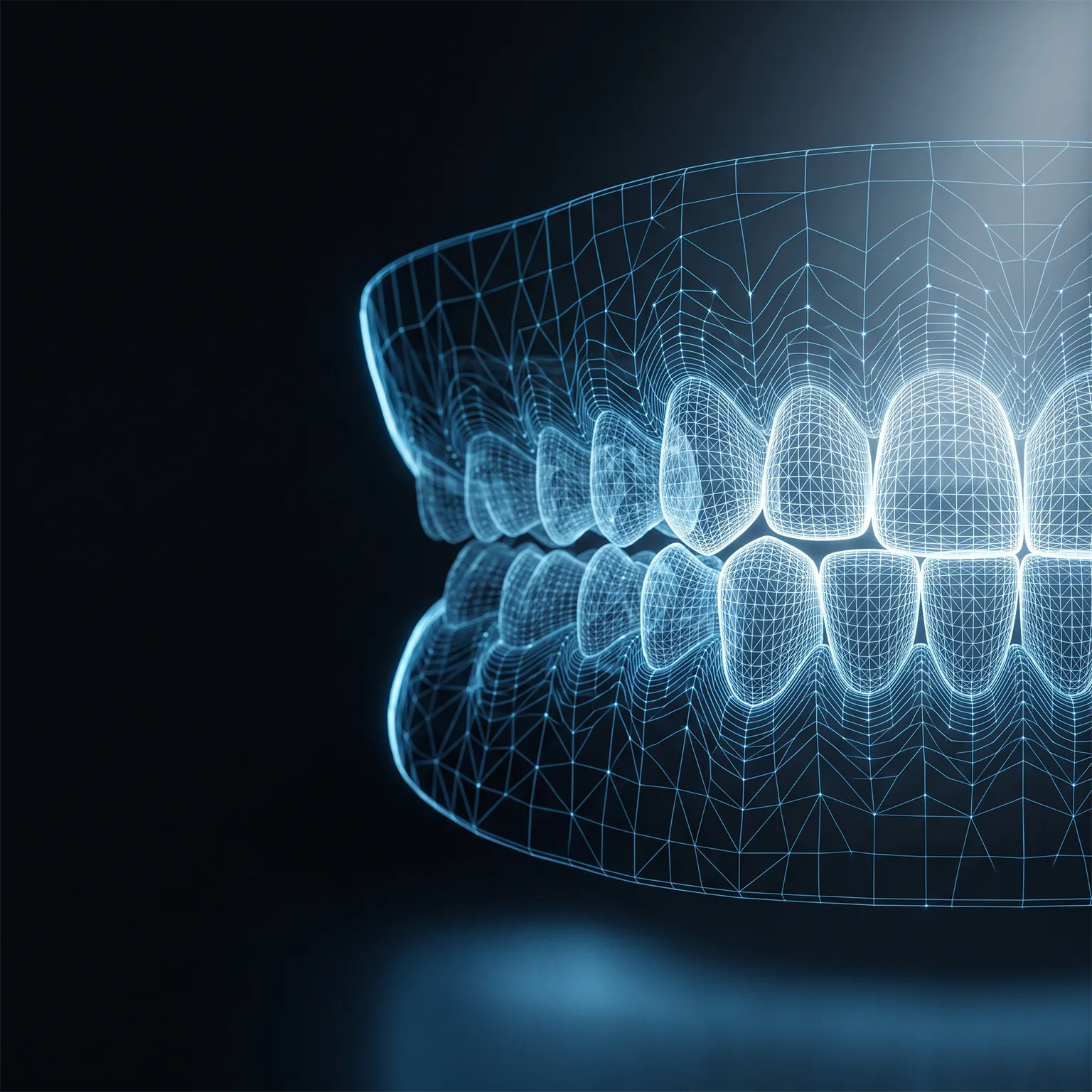
“Turkey teeth” — also widely searched as “Turkish teeth” — is a social-media nickname for a very white, very uniform smile — and, more importantly, for how that look is too often achieved: healthy teeth filed down to small pegs and capped with crowns. The phrase describes the over-treatment, not the country; the same aggressive approach happens worldwide, but it became attached to Turkey because of the cheap package deals marketed there.
Few phrases have done more to scare patients away from dental work abroad. It trends on social media, fills news headlines and shows up in horror-story videos — yet very few people can say what it actually means. It is not really about Turkey at all, and not even about the bright white smile it describes. It is about how that smile is made — and a specific, avoidable mistake that can happen anywhere. Here is a clear explainer, written from arranging dental treatment in Istanbul since 2012.
Where the phrase comes from
“Turkey teeth” began as a nickname for a particular look: a row of very white, very even, almost luminous teeth — the kind seen on reality-TV stars and influencers who travelled abroad for a fast smile makeover. Because so many of those makeovers were filmed, posted and openly priced as budget packages in Istanbul, the slang stuck, and a wave of “before and after” and “I regret my Turkey teeth” videos pushed it into the mainstream. The British Dental Association and UK press have since used the phrase repeatedly in warnings about cosmetic dental tourism, which cemented it further.
The trouble is that the phrase quietly shifted meaning. It stopped describing a colour and started describing a procedure — the way that uniform white is too often achieved. And that is where the real story sits.
What “Turkey teeth” really refers to
Behind the viral term is an uncomfortable clinical reality: in the worst cases, healthy teeth are filed down to small pegs and capped with crowns across the whole mouth — when the patient only wanted them to look better.
That over-preparation is the actual problem. It is not unique to Turkey; the same aggressive approach has been documented in clinics around the world. It simply became associated with Turkey because of the volume of cut-price package deals marketed there. The dentistry, not the geography, is the issue. As the British Dental Association and other dental bodies have repeatedly warned, irreversibly cutting down healthy teeth for purely cosmetic reasons carries real, lifelong consequences.
Crowns vs minimal-prep veneers — the difference that matters
To understand why over-filing is the heart of “Turkey teeth,” you have to understand the two treatments that get confused.
- A crown is a full cap that fits over the entire tooth. Fitting one means grinding the tooth down all the way around — a large, permanent reduction. Crowns are the right repair for a tooth that is genuinely broken, decayed, root-treated or heavily worn.
- A veneer is a thin shell — roughly half a millimetre — bonded only to the front of the tooth. A well-planned, minimal-prep veneer removes just a sliver of enamel, leaving the core of the tooth intact.
The “Turkey teeth” stories almost always come down to one thing: patients who should have had minimal-prep veneers (or nothing at all) were instead given crowns on healthy teeth. Crowning a sound tooth purely for looks is over-treatment, and because enamel does not grow back, it cannot be undone. We cover the choice in full — materials, lifespan, cost and which tooth needs which — in our honest guide to veneers vs crowns.
The three treatments behind the term
“Turkey teeth” is talked about as one thing, but it is really a label stuck onto three very different restorations — and knowing which is which is the first step to avoiding a regret:
| Veneer (minimal-prep) | Crown | Implant | |
|---|---|---|---|
| What it is | A thin shell, roughly half a millimetre, bonded to the front of the tooth | A full cap fitted over the entire tooth | A titanium post replacing a missing tooth, with a crown on top |
| Healthy tooth removed | A sliver of enamel from the front face | The tooth is ground down all the way around | None — there is no tooth left to reduce |
| The right choice when | Shape, colour or minor alignment needs changing on a healthy tooth | The tooth is genuinely broken, decayed, root-treated or heavily worn | A tooth is missing altogether |
| Can it be undone? | No — enamel never grows back, but the loss is small | No — the reduction is permanent and the tooth will always need a crown | Not applicable; no healthy tooth is touched |
| Its part in “Turkey teeth” | What most people chasing the look actually needed | The destructive one, when used on healthy teeth instead of veneers | Searched as “turkey teeth implants,” but a different job entirely |
The mistake at the heart of the horror stories is using the most destructive of these (crowns) where the least destructive (veneers, or nothing) would have done. How long each lasts and how to make a result endure is set out in our guide to how long Turkey teeth last.
Why the over-filing is the real danger
A bright smile is not dangerous. Removing healthy tooth structure that did not need removing is. When teeth are aggressively prepped for crowns they never required, the risks are concrete:
- Nerve damage. Cutting close to the pulp can inflame or kill the nerve, sometimes leading to root canals — or extractions — on teeth that started out perfectly healthy.
- Lasting sensitivity. Reduced teeth can stay sensitive to hot and cold long after the work is done.
- Gum problems. Bulky or poorly fitted crowns trap plaque at the gum line and can drive inflammation and recession.
- It is permanent. Once enamel is gone it is gone. Those teeth will need a crown or veneer for the rest of your life.
- Expensive to put right. Fixing a bad result means re-doing crowns, treating the gums or, in severe cases, implants — more treatment on teeth that are already reduced.
None of this is an argument against cosmetic dentistry, or against having it in Turkey. It is an argument against having the wrong procedure — anywhere. For a fuller, honest account of how these results go wrong, the red flags that precede them and what recourse exists, see our guide to Turkey teeth gone wrong. The safety questions that genuinely matter abroad — sterilisation, diagnosis, qualifications and aftercare — are covered separately in is dental treatment in Turkey safe?
Can “Turkey teeth” be fixed or reversed?
This is the question that matters most to anyone who already regrets their smile — and the honest answer has two parts.
Truly reversed? No. Once enamel has been ground away it does not grow back, so a prepped tooth will always need a crown or veneer over it. There is no putting the tooth back to how it was.
Improved? Often, yes — but it is more dentistry, not less. Depending on what went wrong, a remedial plan might involve:
- Re-making the crowns to a better fit, shade and shape, with a properly sealed margin at the gum;
- Treating the gums where bulky or overhanging crowns have caused inflammation or recession;
- Root canal treatment for a tooth whose nerve was damaged by the original preparation;
- Extraction and a dental implant where a tooth has been over-prepped or has failed beyond saving.
Each of those is real treatment on teeth that are already reduced, which is precisely why the first decision has to be conservative. The cheapest, safest and most predictable “Turkey teeth” is the one that was never over-prepped in the first place. If you are living with a result you are unhappy with, a careful re-assessment — tooth by tooth, with X-rays — is the place to start, not another full set.
The cost trap: why “too cheap” is the warning sign
A surprisingly large part of the “Turkey teeth” problem is hidden in the price. A very low, all-in headline figure for “a full set” is attractive precisely because it sounds like a bargain — but that pricing model is itself the red flag.
Cosmetic dentistry done properly is priced per tooth, after an examination, because the number and type of restorations are different for every mouth. When a clinic can quote one flat price for everyone before seeing anyone, it is usually because everyone gets the same thing: a full arch of crowns, fitted fast, on a production line. The low price is not generosity; it is volume.
To put real numbers on it: at our partner clinic in Istanbul, porcelain or E-max veneers start from about €220 per tooth and zirconium crowns from about €160 per tooth, both as all-inclusive starting points, with a full smile makeover usually 16–20 teeth priced per tooth. Your exact figure is confirmed only after a dentist reviews your photos or X-rays, because the number and type of restorations differ for every mouth — which is precisely why one flat price quoted before anyone has looked is the red flag.
The false economy then shows up later. Repairs, gum treatment, replacement crowns and — in the worst cases — implants cost far more than the conservative treatment would have, and they are needed sooner. A realistic, itemised quote that names each tooth and material is a better sign than the lowest number you can find. You can see honest, per-tooth starting prices and how Turkey compares with the UK and USA in our dental cost guide and our Turkey vs UK & USA comparison.
The conservative alternative
A bright, natural smile and “Turkey teeth” are not the same thing. The conservative alternative is not a different colour chart — it is a different philosophy:
- Diagnose before treating. A responsible dentist examines which teeth are actually damaged before quoting anything. The answer to “how many teeth need work?” is rarely “all of them.”
- Prefer the least destructive option. Whitening first if colour is the only issue; minimal-prep veneers where shape or alignment needs changing; crowns reserved for teeth that are genuinely compromised. Sometimes orthodontics is the more conservative route than veneers at all.
- Aim for natural, not blinding. A good result is even and age-appropriate, with translucency that mimics real enamel — not an oversized, uniform, unnaturally white block.
- Document and consent. A written plan, the number of teeth, the materials and your informed consent in writing, plus a clinical report you can take to any dentist afterwards. The General Dental Council treats valid, informed consent as a core standard of care — and that standard does not change because treatment happens abroad.
A well-planned result is defined by what it is not: not a blinding, oversized, perfectly uniform block of white. The teeth are even and clearly brighter, but they keep the proportions and translucency of real enamel. That restraint is the whole difference, and it is a decision made at the planning stage — not something you can ask for after the drilling has started.
That is the difference between a smile you are happy with for fifteen years and a “Turkey teeth” regret. You can see the conservative treatments themselves on our dental veneers and zirconium crowns pages, or browse the full dental treatment range.
Is a smile makeover actually right for you?
Before any drilling, the more useful question is whether you need restorations at all. Working from least to most invasive:
- If the only issue is colour, professional whitening — not veneers or crowns — is the first answer. Healthy teeth that are simply stained do not need to be cut.
- If the issue is small chips, minor gaps or worn edges, composite bonding — resin added to the tooth with little or no enamel removed — is the most conservative, reversible fix, while minimal-prep veneers on the teeth that show correct larger changes and keep each tooth largely intact.
- If teeth are crooked, orthodontics (including clear aligners) is often the more conservative route than masking misalignment behind a row of veneers.
- If a tooth is genuinely broken, decayed or root-treated, that is when a crown earns its place — as a repair, not a cosmetic default.
Most smiles end up needing a mix, decided tooth by tooth — which is the whole point. A plan worth trusting is the one built after an examination, tooth by tooth.
How to avoid becoming a horror story
The red flags are easy to spot once you know them:
- A clinic that quotes “crowns” or “a full set” before anyone has examined which teeth are actually damaged.
- A single flat price for everyone, instead of an itemised, per-tooth quote.
- Pressure toward a blinding, oversized, uniform white instead of a natural, age-appropriate look — the classic Hollywood smile done badly.
- No written treatment plan, no informed consent and no clinical report to take home.
- An answer of “all of them” when you ask how many teeth genuinely need work.
A clinic that does it properly works the opposite way — it diagnoses before it sells, tells you tooth by tooth what is needed, prepares conservatively and documents everything. Alpha Clinic Turkey organises treatment at accredited partner clinics and has no in-house dentist of its own, so the clinical decision always belongs to the treating dentist, made on the evidence rather than on a sales target.
Frequently asked questions
What are “Turkey teeth”?
“Turkey teeth” is a slang term for a very white, very uniform smile created by filing healthy teeth down to small pegs and capping them with crowns. It is not an official dental treatment — it is a nickname that describes an over-aggressive approach to a cosmetic smile makeover, usually crowns placed where minimal-prep veneers (or nothing) were all that was needed. The name points at the over-treatment, not the country.
What does “Turkey teeth” actually mean?
It is a social-media nickname for a very white, very uniform smile — but the term has come to stand for how that look is often achieved: healthy teeth filed down to small pegs and capped with crowns. The phrase describes the over-treatment, not the country. The same aggressive approach happens in many places; it simply became associated with cheap package deals abroad.
Are “Turkey teeth” permanent, and are they safe?
The preparation is permanent: once enamel is filed away it does not grow back, so a prepped tooth needs a crown or veneer over it for life, replaced periodically. Safety depends entirely on the method, not the country. Done conservatively — minimal-prep veneers only where genuinely indicated, by a properly equipped clinic — a bright smile is safe. Done destructively, with crowns ground onto healthy teeth, it risks nerve damage, sensitivity and gum trouble.
How much are “Turkey teeth”?
There is no single figure for a “full set,” because cosmetic dentistry is priced per tooth after an examination. As all-inclusive starting points at our partner clinic in Istanbul, porcelain or E-max veneers begin from about €220 per tooth and zirconium crowns from about €160 per tooth, with a full smile makeover usually 16–20 teeth. Because the figure follows the examination, the itemised plan you approve is the one you pay.
How long do “Turkey teeth” last?
It depends on what you actually have: well-made porcelain or E-max veneers and crowns typically last 10–15 years and often longer, composite veneers around 5–7 years, and a dental implant’s titanium post decades or a lifetime with its crown renewed every 10–15 years. But the preparation is permanent — once enamel is removed the tooth will always need a veneer or crown over it, replaced periodically. Lifespan depends on the material, your bite, grinding and hygiene, not on the country.
Are “Turkey teeth” bad for you?
The look itself is not the problem — the method behind it can be. When healthy teeth are aggressively ground down for crowns that were never needed, it is irreversible and can lead to nerve damage, sensitivity, gum trouble and costly repairs later. Done conservatively, with minimal-prep veneers only where they are genuinely indicated, a bright smile need not involve any of that.
What is the difference between “Turkey teeth” crowns and veneers?
A crown caps the whole tooth and needs a large amount of structure removed; a veneer is a thin shell bonded to the front, needing only a little enamel. The “Turkey teeth” regrets almost always involve crowns placed on healthy teeth that should have had minimal-prep veneers — or nothing at all. The difference is how much of your own tooth is removed for good.
Can “Turkey teeth” be fixed or reversed?
No, not truly reversed — once enamel is removed it does not grow back, so a prepped tooth will always need a crown or veneer. A poor result can sometimes be improved by re-doing the crowns, treating the gums, root-treating a tooth whose nerve has died or, in severe cases, removing a tooth and placing an implant. But that is more treatment on already-reduced teeth, which is exactly why the first decision must be conservative and made tooth by tooth.
Why are “Turkey teeth” so cheap, and is cheap a bad sign?
A very low headline price usually means volume: the same full set of crowns sold to everyone, fitted fast, with little diagnosis and no real aftercare. Done properly, cosmetic dentistry is priced per tooth after an examination, because the number and type of restorations differ for every mouth. Because the figure follows the examination, the itemised plan you approve is the one you pay.
Is a Hollywood smile the same as “Turkey teeth”?
Not necessarily. A Hollywood smile simply means a full cosmetic redesign of the visible teeth. It becomes “Turkey teeth” only when it is done destructively — crowns on healthy teeth, an unnaturally uniform white, no diagnosis or consent. The same makeover, planned conservatively with the least invasive option per tooth and a natural shade, is a perfectly legitimate treatment.
The bottom line
“Turkey teeth” is a misleading name for a real problem. The problem is not Turkey, and it is not a bright smile — it is healthy teeth being ground down for crowns they never needed, sold as a one-price package before anyone has looked. Get the diagnosis right and the rest follows: whitening or minimal-prep veneers where they help, crowns only for teeth that are genuinely damaged, an honest per-tooth quote, and a natural result you approve before anything is bonded. If you are weighing up a smile makeover, read our veneers vs crowns guide, our honest accounts of Turkey teeth gone wrong and how long Turkey teeth last, our Hollywood smile explainer, check the dental cost guide, browse the whole dental treatment range, see how it works if you are combining dental work with a hair transplant in one trip, or send photos of your smile through the free consultation for a conservative, tooth-by-tooth plan and an honest, all-inclusive quote.